Why do some faces look natural after a facelift, while others look pulled tight? It’s not about the name of the technique
“I’m afraid I won’t look like myself anymore.”
“I don’t want it to be obvious that I’ve had a facelift.”
“The main thing is to avoid that ‘pulled’ look.”
For many patients, this is the primary fear regarding facelifts.
It’s not the surgery itself, the anesthesia, or the travel—it’s the result: a changed facial expression that makes others instantly realize, “She’s had something done.”
The good news is that a natural look isn’t a matter of luck.
And, contrary to popular belief, it isn’t the result of just one “correct” technique.
Let’s explore why two technically successful surgeries can yield vastly different results.
In this article
The word “facelift” is misleading
It suggests a simple scenario: the surgeon removes excess skin, pulls the remaining skin tight, and the face looks younger.
This very image is the root of the fear of the “mask-like” effect.
In reality, it’s not just the skin that changes with age.
The ligaments supporting the soft tissues weaken, the tissues shift downward, volume redistributes, and the jawline loses definition.
That is why modern surgery focuses not on the skin, but on what lies beneath it.
And this leads us to the first rule.
The skin shouldn’t do all the work
If the result relies on skin tension, the face changes in ways we don’t expect.
Skin is an elastic tissue.
When stretched, it flattens a naturally rounded, voluminous cheek and pulls wrinkles into directions that don’t occur in nature.
This is precisely what is perceived as a “done” face—not the number of years removed, but the unnatural geometry.
Excessive skin tension has more visible consequences, too: a shifted hairline, widened scars, and an elongated earlobe.
Therefore, achieving a natural result isn’t simply a matter of “pulling less.”
Quite the opposite: it involves performing the necessary correction but distributing the tension so that the skin doesn’t bear the entire load.

Every face has its own direction
There is a second reason why a “one-size-fits-all” surgery doesn’t exist.
Tissues descend differently in different people.
In a study where surgeons measured the direction of tissue movement in 71 patients during surgery, the average lifting angle was approximately 71 degrees for the deep layer and about 58 degrees for the skin.
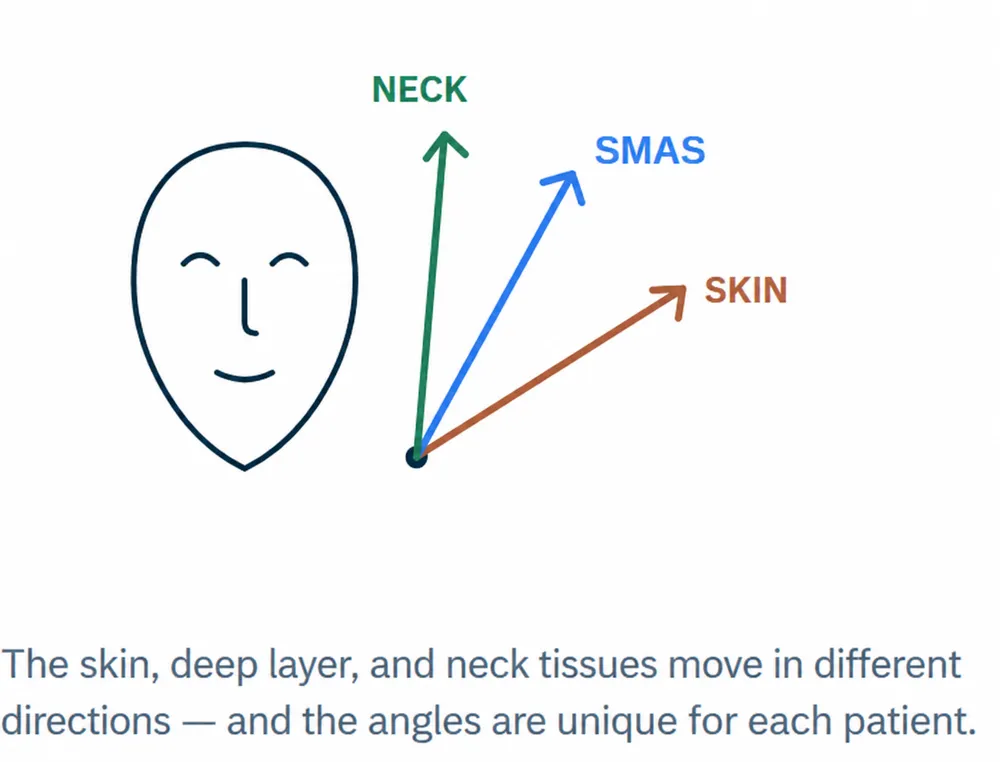
Two things are worth noting here.
First: the skin and the deep layer are moved in different directions.
It’s not just “everything up together.”
Second: the “vertical vector” often promised in advertisements is an oversimplification.
Even for proponents of a strictly vertical approach, the measured angle turns out to be oblique; furthermore, an excessively vertical lift carries its own side effects, such as hairline displacement and distortion of the outer corner of the eye.
For the patient, the conclusion is simple:
That is precisely why two women presenting with the same complaint—”jowls have appeared”—may require different surgical procedures.
A natural look relies on preserving specific details.
There are features we do not notice as long as they remain in their proper place.
The earlobe.
The sideburn.
The hairline behind the ear.
The shape of the tragus.
The transition from the cheek to the ear.
The eye perceives them as standard anatomy.
But if the earlobe stretches downward and seems to fuse with the cheek, if the temple area shifts upward, or if a step-like irregularity appears in the hairline behind the ear, a person with no knowledge of plastic surgery will still sense that something is amiss.
Moreover, what they sense is precisely that irregularity, not the facelift itself.

In a series of 105 operations, the incidence of such aesthetic complications was 4%: earlobe deformity (1%), displacement of the auricle (2%), and hypertrophic scarring (1%).
These figures may seem low, yet it is precisely these details that create the impression of an “operated-on face,” even when the facial contour itself has turned out perfectly.
A second question matters just as much: does the face still look like itself?
What about the “deep plane” technique?
Nowadays, “deep plane” is often marketed as synonymous with a natural-looking facelift.
There is logic to this, and the technique is certainly more than just a marketing buzzword.
It has a clear mechanism.
The surgeon accesses a deeper tissue layer and releases the facial retaining ligaments.
Anatomical studies involving fifty cadaver specimens demonstrated that as long as these ligaments remain intact, tissues can only be pulled tight—resulting in the loss of the very support structure that held the face up against gravity.
Releasing the ligaments allows for the repositioning of the central face, not just the sides.
However, there is a gap between the technique itself and the final result.
The name of the technique doesn’t guarantee how the face will look. In a comparative study of forty patients, four surgeons evaluated photographs without knowing which procedure had been performed.
For patients under the age of seventy, the deep plane technique showed no advantage.
The conclusion isn’t that the deep plane technique is unnecessary.
The conclusion is different:
Naturalness is determined by what they *actually do* within that layer.
That’s why asking “Do you perform the deep plane technique?”
is useful but insufficient—almost everyone who advertises lists this technique.
What sets a surgeon apart isn’t the name of the procedure, but the answer to a second question:

If your main priority is looking like yourself…
…don’t choose a surgeon based on the term “deep plane.”
And don’t judge the outcome by the degree of change seen in “before and after” photos.
Look at something else instead: how consistent the results are across different patients and whether individual features are preserved.
It’s an operation where the changes are noticeable, but the surgery itself isn’t.
The next question usually goes something like this:
“Okay. But how do I know if I’m dealing with a truly skilled surgeon, rather than just a polished social media profile?”
We’ve also compiled a ranking of facelift surgeons in Turkey — covering a range of experience, approaches, aesthetic styles, and price points.
What this article is based on
Anatomy of the facial ligamentous system — a study of 50 cadaver specimens, Plastic and Reconstructive Surgery · Individual lifting vectors — intraoperative measurements from 71 patients, Aesthetic Surgery Journal · Comparison of deep plane and SMAS plication — blinded photo assessment of 40 patients by four surgeons, Archives of Facial Plastic Surgery · Characteristic post-lift deformities — StatPearls clinical reference guides, Cervicofacial Rhytidectomy and Deep Plane Facelift · Incidence of aesthetic complications — a series of 105 surgeries, Aesthetic Surgery Journal · Quality of “before and after” photos — analysis of 567 publications, Facial Plastic Surgery & Aesthetic Medicine, and 291 publications, Aesthetic Surgery Journal ·
This material is for informational purposes only and does not replace an in-person consultation with a plastic surgeon.
Updated: September 10, 2026